
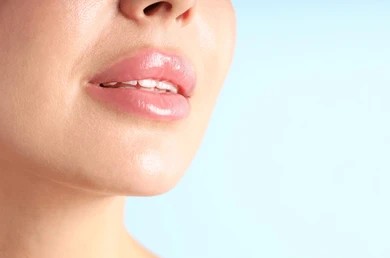
Introduction: What is an Upper Lip Lift?
An upper lip lift (often referred to as an upper lip reduction or lip shortening procedure) is a surgical technique designed to shorten the distance between the nose and the upper lip (philtrum) while enhancing vermilion show, lip eversion, and dental display.
Unlike fillers—which add volume—this procedure repositions anatomy for a more youthful, proportionate appearance .
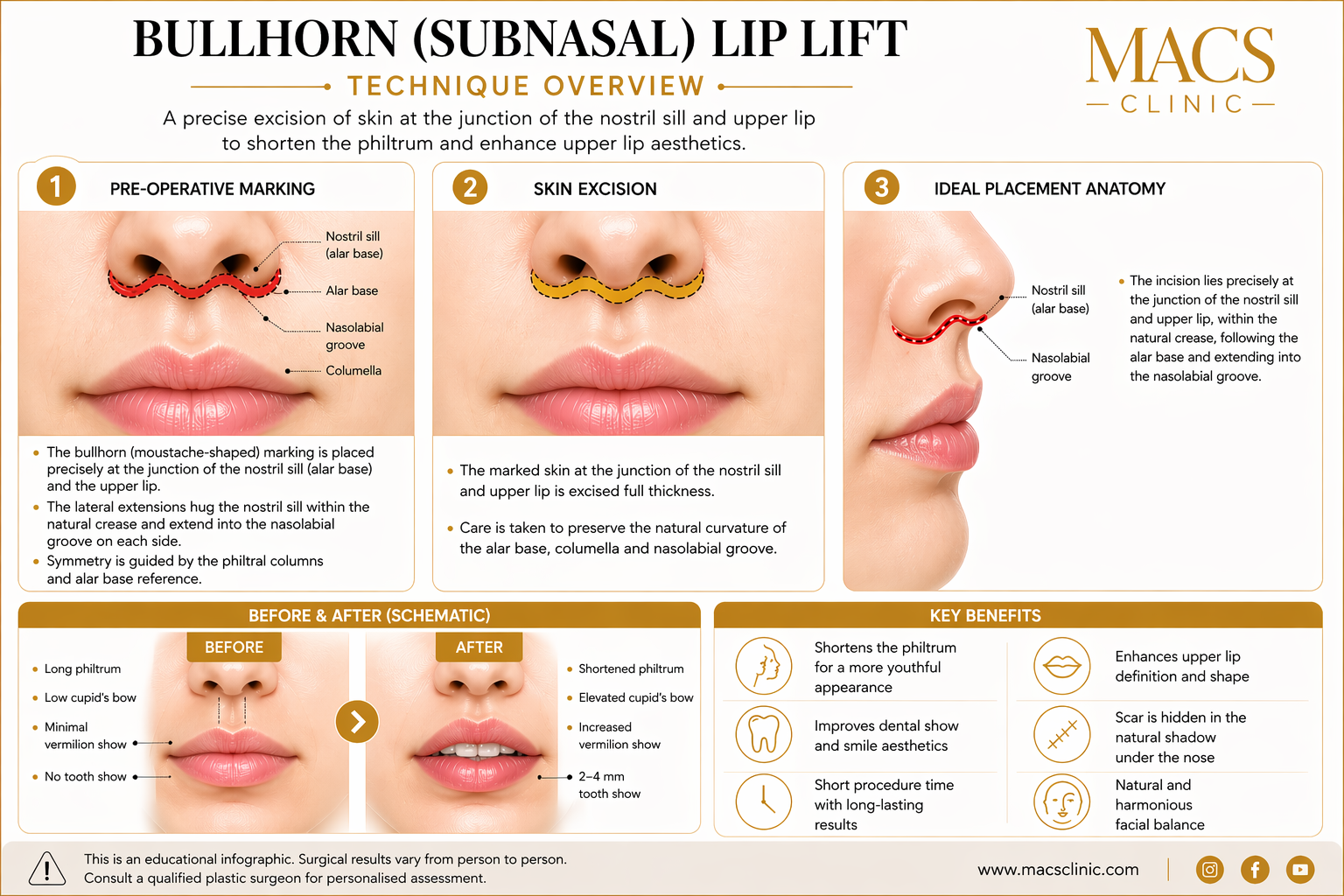
The most widely used technique is the subnasal “bullhorn” lip lift, which removes a strip of skin beneath the nose and elevates the lip.
Why is it Becoming Increasingly Popular?
- Shift from overfilled lips → anatomical refinement
- Desire for natural, long-term results
- Recognition that elongated philtrum ≠ volume deficiency
- Strong role in:
- Facial rejuvenation
- Gender-affirming procedures- is not offered at MACS Clinic
- Perioral balance restoration
Indications (Who is a Suitable Candidate?)
Primary Indications
- Elongated philtrum / upper lip
- Reduced upper incisor (front teeth) show at rest
- Thin or involuted upper lip
- Poor lip eversion (flat or inward-rolled lip)
- Age-related perioral elongation
- Failed or overuse of fillers
Functional/Aesthetic Indicators
- Lack of dental show on smiling
- Poor Cupid’s bow definition
- “Tired” or aged lower face appearance
Important Exclusions / Caution
- Very short philtrum (risk of overcorrection)
- High maxilla or skeletal discrepancy
- Keloid-prone individuals
- Unrealistic expectations
👉 Ideal candidates are those where structure—not volume—is the core issue.
Pre-operative Planning (Critical for Outcomes)
This is arguably the most important step.
Assessment Framework
- Philtrum length (objective + aesthetic)
- Vermilion height
- Dental show (static and dynamic)
- Nasal base anatomy
- Skin quality and scar tendency
- Facial proportions (lower third balance)
Planning Principles
- Conservative skin excision (“less is more”)
- Symmetrical marking is essential
- Avoid over-resection → unnatural results
Surgical Techniques
- Subnasal “Bullhorn” Lip Lift (Gold Standard)
- Most commonly performed technique (~75% cases)
- Skin excision beneath nasal base in bullhorn shape
- Advantages:
- Reliable lift
- Good scar camouflage in nasal crease
- Disadvantage:
- Permanent scar (though often well hidden)
- Gullwing (Direct Lip Lift)
- Incision along vermilion border
- More visible scar
- Used selectively (e.g., precise vermilion enhancement)
- Italian Lip Lift
- Two small incisions under nostrils
- Subtle lift
- Less aggressiv
- Endonasal / Modified Techniques
- Aim to hide scars internally
- Technically demanding but effective in selected cases
Step-by-Step (Bullhorn Lip Lift – Conceptual)
- Precise marking under nasal base
- Excision of predetermined skin segment
- Optional muscle modification
- Superior advancement of lip
- Layered closure to minimise tension
👉 Outcome:
- Shorter philtrum
- Increased vermilion show
- Improved dental display
Post-Operative Care
Immediate (0–7 days)
- Mild swelling and bruising expected
- Head elevation
- Cold compress
- Antibiotic ointment to incision
- Avoid excessive lip movement
Early Phase (1–3 weeks)
- Sutures removal (5–7 days typically)
- Scar begins to settle
- Gradual return to normal activity
Late Phase (3–12 weeks)
- Scar maturation phase
- Final results become visible
Scar Management (Critical Discussion)
This is a non-negotiable part of consent and outcome.
Key Points
- The procedure always leaves a permanent scar
- Usually hidden at nasal base shadow
- Visibility depends on:
- Skin type
- Surgical precision
- Post-op care
Scar Optimisation Strategies
- Silicone gel/sheets
- Sun protection (SPF mandatory)
- Steroid injections (if hypertrophic)
- Laser therapy if required
Scar Camouflage (Important Patient Education)
- Makeup techniques
- Medical tattooing (paramedical micropigmentation)
- Must be discussed pre-operatively
Complications and Limitations
Early Complications
- Swelling, bruising
- Hematoma
- Infection
Late Complications
- Visible scar / hypertrophic scar
- Asymmetry
- Overcorrection (“gummy” appearance)
- Nasal distortion (if poorly planned)
- Reduced lip mobility
Complications such as asymmetry, hematoma, and scarring are documented, particularly with excessive tissue removal.
Longevity of Results
- Considered long-lasting structural change
- Some minor relaxation over years may occur
- Significant improvement maintained long-term
Lip Lift vs Fillers – A Critical Distinction
Lip Lift | Fillers |
|---|---|
Structural change | Volume addition |
Permanent | Temporary |
Improves dental show | Does not |
Reduces philtrum length | No effect |
Leaves scar | No scar |
👉 Often, the best outcomes come from correct diagnosis—not default filler use.
Upper Lip Lift – At a Glance
Indications
- Long philtrum
- Thin upper lip
- Poor tooth show
Procedure
- Local anaesthesia
- Skin removal under nose
- Lip elevated
Results
- Fuller, youthful lip
- Better smile
Recovery
- 5–7 days sutures
- 2–3 weeks settling
Key Consideration
⚠️ Permanent scar → must be accepted and managed
MACS Clinic Philosophy
- Precision over aggression
- Anatomy-driven planning
- Ethical patient selection
- “No surgery is always an option”
- Transparent discussion of scar trade-offs
Final Thought
The upper lip lift is one of the most powerful yet misunderstood procedures in facial aesthetics.
When performed on the right patient, with the right indication, and with surgical restraint, it produces natural, elegant, and long-lasting rejuvenation.
When performed indiscriminately, it can lead to visible scars and unnatural results.
Contact MACS Clinic
- Phone: 020 7078 4378
- WhatsApp: 07792 648 726
- Email: enquiries@macsclinic.co.uk
- Website: www.macsclinic.co.uk
- BOOK a FREE Video Consultation: https://calendly.com/macsclinic/free-video-consultation?month=2025-01