
By Dr Shailesh Vadodaria, Consultant Plastic Surgeon
MACS Clinic | Watford and Harley Street, London
Introduction: A Small Problem That Can Make a Big Difference
Our ears are an important part of facial appearance, and earrings have been worn for centuries as symbols of beauty, fashion, tradition, and personal identity.
Unfortunately, the soft tissues of the earlobes can gradually stretch, become elongated, or split completely. This may occur after years of wearing earrings, as a consequence of ageing, or following accidental injury.
For many patients, a widened piercing hole or split earlobe is more than a minor cosmetic concern. It may prevent them from wearing their favourite earrings, affect the symmetry of their ears, or make them feel self-conscious about their appearance.
At MACS Clinic, Dr Shailesh Vadodaria offers surgical correction of stretched, partially split, and completely split earlobes.
The procedure is generally performed under local anaesthetic as a day case, without the need for general anaesthesia or an overnight hospital stay.
Our aim is to restore a natural, aesthetically pleasing earlobe contour while preserving as much healthy tissue as possible.

1. Understanding the Anatomy of the Earlobe
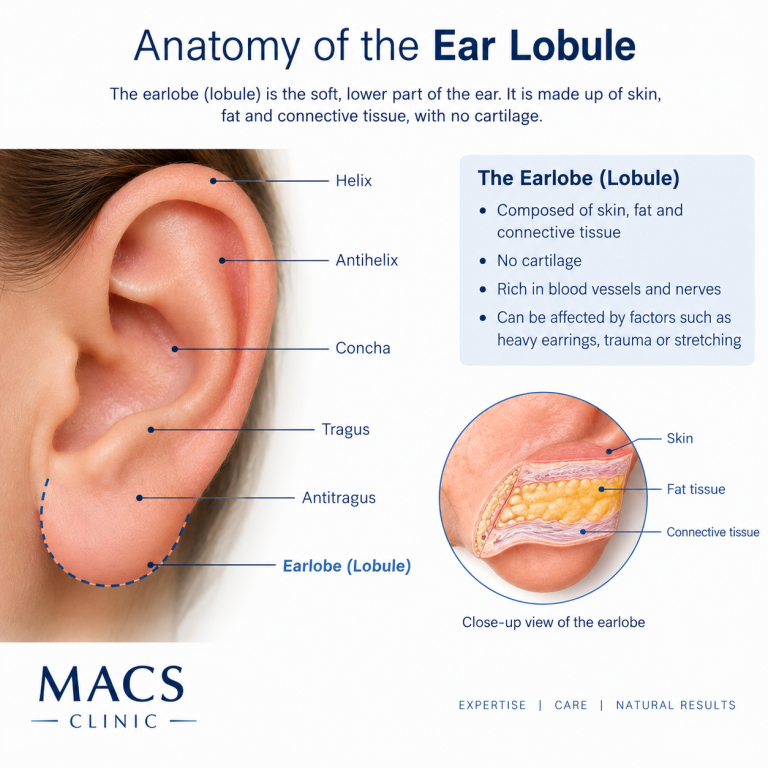
The earlobe, also called the lobule, is the soft, rounded, lowermost portion of the external ear.
Unlike the upper part of the ear, which is supported by elastic cartilage, the earlobe contains no cartilage.
It is composed principally of:
* Skin and dermal connective tissue
* Collagen and elastin fibres
* Subcutaneous fatty and fibrous tissue
* Small blood vessels and sensory nerves
The absence of cartilage makes the earlobe soft, flexible, and suitable for piercing.
However, it also means that the earlobe has limited internal structural support. It is particularly susceptible to repetitive traction, gravitational forces, and age-related changes in skin elasticity.
The quality and strength of the surrounding dermal connective tissue are therefore important in maintaining the shape of a pierced earlobe.
2. Why Do Earlobes Stretch or Split?
There is rarely one single cause. Several factors may act together over many years.
A. Ageing and weakening of connective tissue
As we grow older, our skin undergoes progressive structural changes.
Collagen architecture changes, elastic fibres become less effective, and the skin gradually loses some of its firmness and elasticity.
The earlobe is particularly vulnerable because it is a dependent, unsupported soft-tissue structure without a cartilaginous framework.
Over time, gravity and repeated loading can contribute to:
* Elongation of the earlobe
* Stretching of existing piercing holes
* Thinning of the tissue below the piercing
* Gradual formation of an elongated cleft
* Increased susceptibility to complete splitting
These changes may be particularly noticeable in patients who have worn earrings for several decades.
Ageing alone does not necessarily cause a split, but it can make the tissues more vulnerable to other mechanical forces.
B. Wearing heavy earrings over many years
Heavy earrings are an important, well-recognised cause of earlobe stretching.
The weight of the earring produces a downward pulling force on the piercing.
Repeated exposure may gradually turn a small circular piercing into a long, vertical opening.
Eventually, the bridge of tissue between the piercing and the lower edge of the earlobe may become extremely thin and tear.
Long, dangling earrings and particularly heavy ornaments may increase this effect.
C. Accidental pulling or direct trauma
Sudden traction can cause partial or complete splitting.
Common examples include:
* An earring becoming caught in clothing
* Pulling an earring while removing a jumper
* A child or baby accidentally pulling an earring
* An earring becoming trapped during sporting activities
* Accidental injury during hairdressing or grooming
* Direct traumatic injury to the ear
A sudden injury may produce a complete split even in an otherwise healthy earlobe.

D. Repeated minor trauma
Not all earlobe injuries happen suddenly.
Repeatedly pulling, twisting, or adjusting earrings may gradually damage the tissues surrounding a piercing.
Sleeping in heavy or dangling earrings may also subject the earlobe to additional traction.
Over time, repeated mechanical stress may cause the piercing hole to enlarge.
E. Poorly positioned or multiple ear piercings
Piercings that are placed too close to the lower edge of the earlobe may leave an insufficient bridge of supporting tissue.
Similarly, multiple piercings positioned close together can weaken the intervening tissue.
These factors may make the earlobe more vulnerable to stretching or splitting.
F. Deliberate stretching of ear piercings
Some people deliberately enlarge their ear piercings by using progressively larger jewellery, sometimes called gauges or ear tunnels.
When stretched beyond the tissue’s ability to recover, the opening may become permanently enlarged.
Large, longstanding openings often require a different reconstructive technique from an ordinary split piercing.
G. Metal allergy and chronic inflammation
An important but sometimes overlooked factor is contact sensitivity to metals used in earrings, particularly nickel-containing alloys.
Persistent inflammation, itching, eczema, or irritation may compromise the surrounding skin.
A published clinical investigation suggested that metal allergy may contribute to acquired splitting in some individuals.
Patients who repeatedly experience redness or itching around their earrings should mention this during consultation.
H. Connective tissue and collagen disorders
Certain inherited disorders affect collagen production, connective-tissue strength, skin elasticity, and wound healing.
One important example is Ehlers–Danlos syndrome (EDS).
Some forms of EDS are associated with:
* Increased skin stretchability
* Tissue fragility
* Easy bruising
* Delayed or abnormal wound healing
* Widened or atrophic scars
These characteristics may increase susceptibility to tissue injury and complicate surgical repair, although specific evidence linking individual collagen disorders to earlobe splitting remains limited.
Patients with known connective-tissue conditions should inform their surgeon, as they may require individualised surgical planning and aftercare.
I. Previous infection, scarring, or surgery
Previous infection around a piercing may damage local tissues or cause scarring.
Similarly, previous earlobe repair, wound breakdown, or repeated piercing through weakened tissue may contribute to further deformity.
J. Congenital earlobe clefts
Rarely, an earlobe may have a cleft or deformity from birth. This differs from an acquired split earlobe and may require a specifically tailored reconstructive technique.
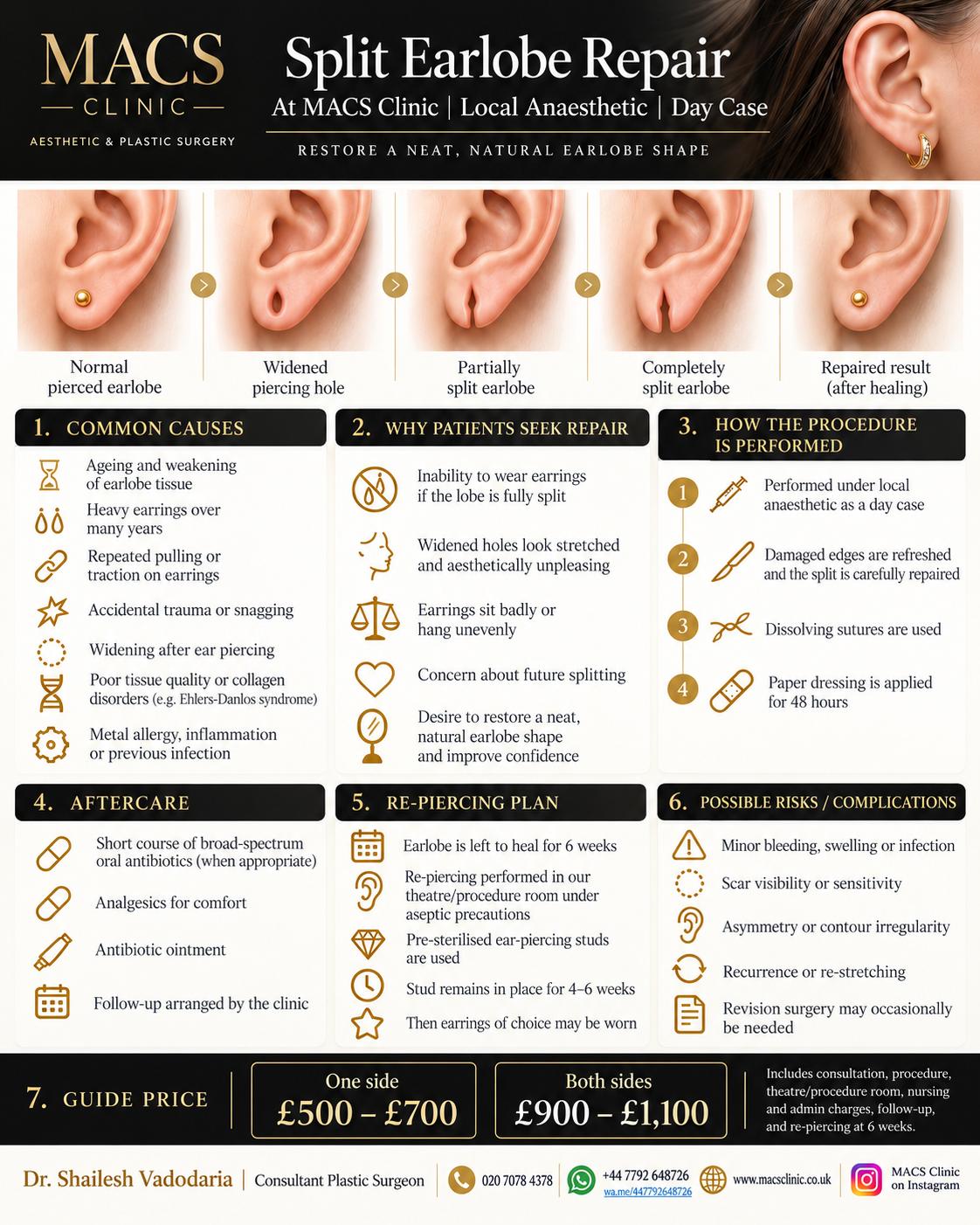
3. Different Types of Earlobe Deformity
Not every widened piercing requires the same operation.
Widened piercing hole: The original circular opening becomes enlarged or oval-shaped, but the lower border of the earlobe remains intact.
Elongated piercing: The opening extends vertically downwards, producing a slit-like appearance.
Partially split earlobe: There is a significant cleft, but a bridge of tissue remains at the lower margin.
Completely split earlobe: The cleft extends all the way through the lower border, dividing the earlobe into two separate segments.
Complex earlobe deformity: There may be multiple splits, scar tissue, tissue loss, previous failed surgery, or significant earlobe stretching.
At MACS Clinic, the precise type of deformity is assessed before selecting the most appropriate surgical repair.
4. Why Do Patients Request Split Earlobe Repair?
Patients seek treatment for a variety of functional, aesthetic, and personal reasons.
Difficulty wearing earrings
A completely split earlobe can prevent conventional earrings from being worn in the original location.
This is particularly upsetting for patients who regularly wear earrings for cultural, personal, or traditional reasons.
Unattractive or elongated piercing holes
Even when an earlobe has not split completely, an enlarged hole may appear unattractive.
Instead of sitting neatly against the ear, an earring may droop, tilt forwards, or hang unevenly.
Concerns about symmetry
One earlobe may be stretched while the other appears normal.
This difference may become particularly obvious when wearing matching earrings.
Fear of complete splitting
Patients with a severely elongated piercing may seek treatment because they are concerned that the remaining tissue will eventually tear.
Restoring confidence
For some individuals, the deformity is a longstanding source of self-consciousness.
Repair can help restore a more balanced appearance and allow patients to consider wearing earrings again after healing.
5. Consultation and Assessment at MACS Clinic
Before surgery, Dr Vadodaria assesses the affected earlobe and discusses the patient’s expectations.
The consultation considers:
* Whether the deformity affects one or both earlobes
* The size, location, and extent of the split
* The amount and quality of remaining tissue
* Previous piercings, surgery, infections, or scarring
* Personal or family history of abnormal scars
* Medical conditions that might affect healing
* Smoking, nicotine use, and relevant medication
* Any known allergies to metals, adhesives, or medicines
* The patient’s wishes regarding future ear piercing
The appearance of the opposite earlobe is also considered to achieve the best practical symmetry.
The aim is to agree on a realistic surgical plan, discuss the limitations and possible risks, and explain the expected healing process.
6. How Is Split Earlobe Repair Performed?
At MACS Clinic, split earlobe correction is normally performed under local anaesthetic in an appropriately equipped clinical operating environment.
Step 1: Local anaesthetic
A small quantity of local anaesthetic is injected into the earlobe.
Patients may feel a brief stinging sensation during injection, but once the anaesthetic has taken effect, the procedure should be comfortable.
The patient remains awake and can communicate with the surgical team throughout.
Step 2: Preparing the earlobe
The earlobe is carefully cleaned using an appropriate skin antiseptic.
The damaged tissue and proposed reconstruction are assessed.
Step 3: Refreshing the damaged edges
The epithelialised or scarred margins of the split are carefully prepared to expose healthy tissue suitable for surgical healing.
The approach depends upon whether the defect is widened, partially split, or completely split.
Step 4: Restoring the natural earlobe contour
The tissues are brought together using a carefully planned repair.
Particular attention is paid to preserving the natural rounded shape of the lower earlobe and minimising notching or distortion at its free border.
Some deformities require more advanced local tissue rearrangement.
Step 5: Dissolving sutures
Dr Vadodaria generally uses fine absorbable (dissolving) sutures to close the wound.
This usually avoids the need for routine suture removal, although a postoperative review remains important.
Step 6: Protective dressing
A small, lightweight skin colour paper dressing is applied over the repaired area.
This is generally kept in place for approximately 48 hours, subject to the individual postoperative instructions.
The patient can normally return home shortly after the procedure.
7. Why Do We Prefer Local Anaesthetic?
For suitable patients, local anaesthesia provides several practical advantages.
Avoidance of general anaesthesia: There is usually no need for general anaesthetic drugs, airway instrumentation, or a prolonged recovery from anaesthesia.
Minimal disruption: Patients remain awake and can often resume routine, non-strenuous activities relatively quickly.
Day-case treatment: An overnight hospital admission is not normally required.
No routine fasting: For an operation under local anaesthetic alone, routine fasting is generally unnecessary unless the clinic provides specific instructions otherwise.
Lower overall resource requirements: Local anaesthesia avoids many of the additional resources associated with a general anaesthetic.
Good patient comfort: The earlobe can be effectively numbed for the procedure.
However, local anaesthesia is not entirely risk-free. Allergic reactions, bleeding, discomfort, and other complications, although uncommon, remain possible.
8. Aftercare Following Split Earlobe Repair
Appropriate postoperative care is important for good healing and an attractive result.
During the first 48 hours
Patients are generally advised to:
* Keep the paper dressing clean and dry.
* Avoid rubbing, pulling, or scratching the earlobe.
* Avoid sleeping directly on the operated ear where practical.
* Avoid heavy earrings or other pressure on the repaired area.
* Follow the clinic’s written instructions regarding washing and wound care.
A small amount of swelling, tenderness, or bruising may be expected.
Medication
Depending on the patient’s circumstances, Dr Vadodaria may prescribe:
Oral antibiotics: A short course of broad-spectrum antibiotics may be prescribed when clinically appropriate, taking account of allergies and individual infection risk.
Analgesics: Simple pain-relieving medication may be recommended for postoperative comfort.
Topical treatment: An appropriate antibiotic ointment may be provided where indicated, with instructions about application and possible skin sensitivity.
Not every patient undergoing uncomplicated clean skin surgery requires antibiotics. Medication is therefore prescribed according to individual clinical assessment.
Over the following weeks
Patients should avoid repeated handling, traction, or pressure on the healing earlobe.
The scar may initially appear pink, firm, or slightly raised. It normally becomes less noticeable over the following months, although complete scar disappearance cannot be guaranteed.
Patients should contact the clinic if they develop increasing redness, significant swelling, persistent bleeding, discharge, worsening pain, or any concern about wound separation.
9. When Can I Have My Earlobe Re-Pierced?
This is one of the most frequently asked questions.
Many patients request earlobe repair specifically because they wish to wear earrings again.
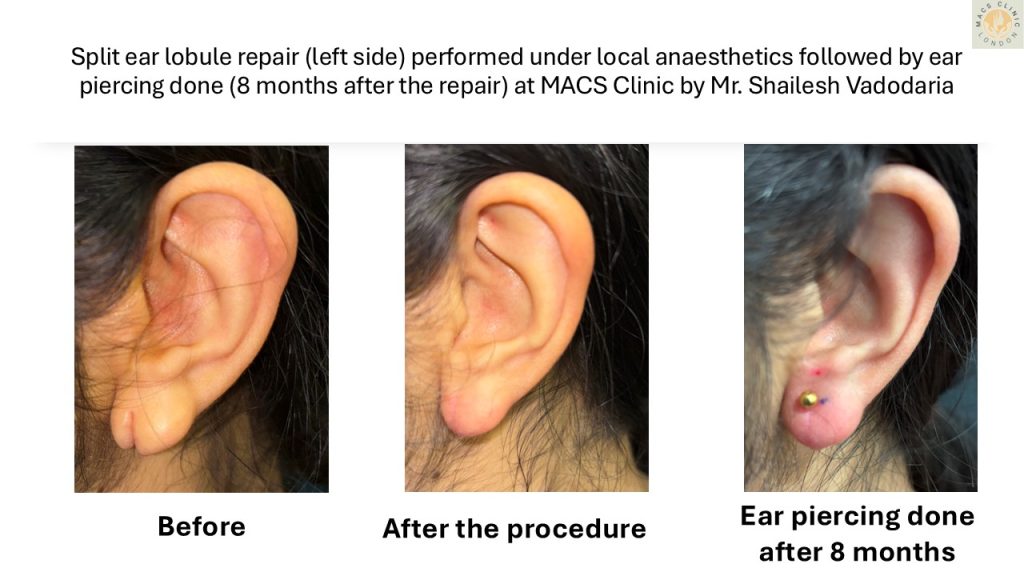
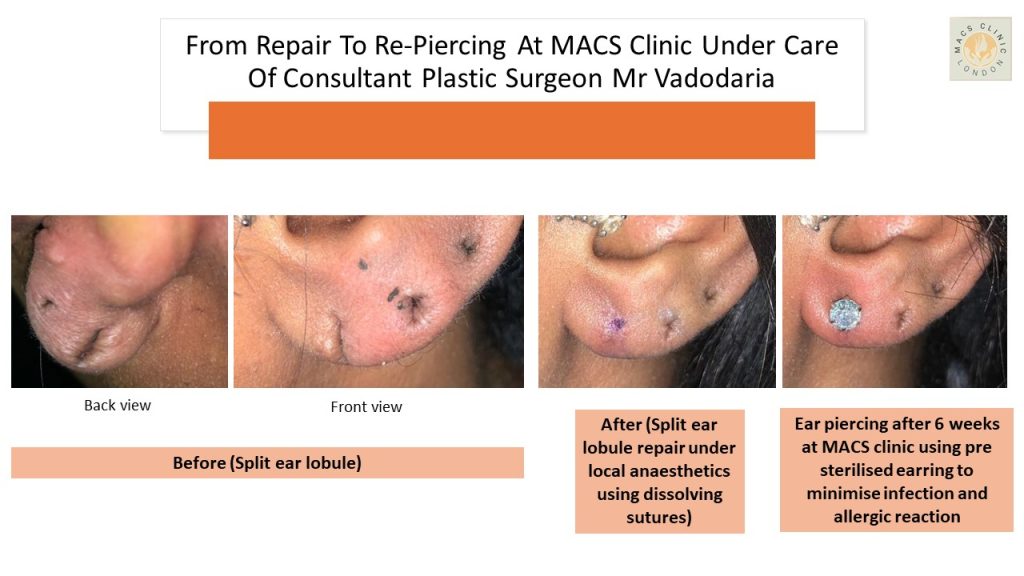
At MACS Clinic, Dr Vadodaria generally plans to review the earlobe for possible re-piercing approximately six weeks after surgery.
Re-piercing at this stage is offered only if the wound has healed adequately and the tissues are considered suitable. Some patients may need a longer healing period.
Our re-piercing pathway
Stage 1 — Initial surgical repair
The widened or split earlobe is repaired using fine dissolving sutures.
Stage 2 — Healing period
The repaired earlobe is allowed to heal over approximately six weeks.
Stage 3 — Examination and re-piercing
Once the repair has been assessed, the earlobe may be re-pierced in the clinic’s operating theatre or designated procedure room using aseptic precautions.
We use purpose-made, manufacturer-sterilised ear-piercing studs suitable for the procedure.
The piercing position is carefully selected to avoid placing unnecessary stress on the repaired scar.
Stage 4 — Initial stud-wearing period
The initial stud is usually kept in place for at least four to six weeks, or longer if required for satisfactory healing.
The piercing should be cared for according to the clinic’s advice, including appropriate cleaning and avoiding unnecessary movement.
Stage 5 — Wearing earrings again
Once the new piercing has healed sufficiently, the patient may gradually return to wearing suitable earrings.
Initially, lightweight earrings are preferable.
Importantly, a piercing may appear healed externally before the internal tract has fully matured. Patients should therefore obtain confirmation before changing jewellery, and some will need to retain their initial stud beyond six weeks.
Why is the piercing position important?
Re-piercing through an immature or weakened scar may increase the possibility of stretching or another split.
An appropriately positioned new piercing through healthy tissue, away from the weakened repair whenever feasible, is therefore an important part of preventing recurrence.
10. Possible Risks and Complications of Split Earlobe Repair
Although split earlobe repair is generally a minor surgical procedure, no operation is entirely free from complications.
Patients should understand the following possibilities before deciding to proceed.
Bleeding or haematoma
A small amount of bleeding or bruising may occur. Occasionally, blood may collect beneath the skin.
Infection
The wound can become infected, potentially delaying healing or affecting the final cosmetic result.
Delayed wound healing
Healing may be slower in patients with poor tissue quality, certain medical conditions, nicotine exposure, or other risk factors.
Wound separation
Occasionally, the wound may partially or completely separate after surgery, particularly if subjected to trauma or premature tension.
Visible scarring
Every surgical repair produces a scar.
While the scar is generally placed carefully to minimise its appearance, it may remain visible.
Hypertrophic or keloid scarring
Some patients develop thickened, raised, or excessively growing scars.
Patients with a previous history of keloids, particularly following ear piercing, should inform the surgeon.
Earlobe asymmetry
The operated earlobe may not match the opposite side perfectly.
Contour irregularity or notching
A small indentation or irregularity may develop at the lower earlobe border.
Altered sensation
Temporary numbness, increased sensitivity, or occasionally persistent sensory change may occur.
Recurrence of stretching or splitting
Recurrence is an important recognised complication.
Repeated traction, heavy earrings, inappropriate re-piercing, tissue fragility, or another accidental injury may cause the new piercing to stretch or split.
Although recurrence has been reported in the surgical literature, reliable contemporary rates vary and cannot be predicted precisely for an individual patient.
Possibility of revision surgery
A small proportion of patients may require further treatment because of recurrent splitting, scarring, wound-healing problems, or an unsatisfactory contour.
Revision surgery may be more complex because previously operated tissue can contain additional scarring.
The need for revision, its likely benefits, and any associated costs would be discussed individually.
11. How Can You Reduce the Risk of Splitting Again?
Patients can take several sensible precautions to protect their repaired earlobes.
1. Choose lightweight earrings. Avoid prolonged use of large, heavy earrings that pull on the piercing.
2. Avoid repeated traction. Take care when dressing, brushing hair, or handling jewellery.
3. Remove unsuitable earrings before sleeping or physical activity. This helps reduce accidental snagging.
4. Choose an appropriate piercing position. Avoid piercing through a fragile scar or too close to the lower earlobe margin.
5. Use suitable jewellery materials. Patients with metal sensitivity should consider appropriate nickel-free, biocompatible jewellery.
6. Allow sufficient healing time. Do not change studs or wear heavy earrings prematurely.
7. Seek advice if the opening begins to enlarge. Early assessment may prevent further stretching or complete splitting.
12. How Much Does Split Earlobe Repair Cost at MACS Clinic?
We aim to provide patients with clear, transparent pricing before treatment.
|Treatment |Guide price |
|——————————————|————–:|
|Unilateral split earlobe repair (one ear) |*£500–£700* |
|Bilateral split earlobe repair (both ears)|*£900–£1,100*|
What is included in the treatment fee?
The quoted fee includes:
* Initial consultation and surgical assessment
* Preoperative assessment and planning
* Surgeon’s professional fee
* Local anaesthetic and surgical repair
* Operating theatre or procedure-room charges
* Nursing charges
* Administrative charges
* Routine postoperative follow-up
* Re-piercing at approximately six weeks, subject to adequate healing
Re-piercing is included in the quoted treatment package, rather than being charged as a separate procedure.
The final fee is confirmed following assessment, taking account of the complexity of the deformity and whether one or both earlobes require correction.
Complex revisions or additional treatment, where needed, are assessed separately.
13. Frequently Asked Questions
Is split earlobe repair painful?
The local anaesthetic injection may cause temporary stinging. Once the anaesthetic has taken effect, the operation should be comfortable.
Mild postoperative tenderness can usually be managed with simple analgesia.
Can both earlobes be repaired during the same appointment?
Yes. In suitable patients, both earlobes can generally be repaired during the same treatment session.
Can an old split earlobe still be repaired?
Yes. Even longstanding splits can often be repaired successfully.
The exact method depends on the remaining tissue, scarring, and earlobe shape.
Will I need stitches removed?
Dr Vadodaria generally uses dissolving sutures, so routine stitch removal is usually unnecessary.
Can an enlarged piercing hole close without surgery?
Minor stretching may sometimes improve after earrings are removed.
However, established elongated or completely split earlobes usually require surgery to restore a more normal contour.
Will my earlobe look completely normal afterwards?
The aim is a natural and aesthetically pleasing contour.
A fine scar will remain, and perfect symmetry or complete restoration of the original earlobe cannot be guaranteed.
How long does recovery take?
Initial wound healing generally occurs over the first few weeks.
Many patients can return to ordinary activities quickly, but the repaired tissues continue to remodel and strengthen over subsequent months.
Can I wear earrings after surgery?
Yes, in many cases, provided the repair heals adequately and a new piercing can be positioned safely under supervision of Mr Vadodaria .
At MACS Clinic, suitability for re-piercing is normally assessed at approximately six weeks.
Can the repaired earlobe split again?
Yes. A repaired earlobe can stretch or split again, particularly if heavy earrings are worn or the piercing is exposed to further injury.
Following the recommended aftercare and choosing lightweight jewellery helps reduce this risk.
What happens if I have a history of keloid scars?
Patients with a history of keloids or abnormal scarring should discuss this during consultation.
They may require additional counselling, altered management, or consideration of whether the benefits of surgery outweigh the risks.
Is earlobe repair suitable for older patients?
Age alone does not necessarily prevent treatment.
The decision depends on general health, skin quality, the extent of the deformity, and the patient’s individual circumstances.
14. Why Choose MACS Clinic?
At MACS Clinic, we believe that even a relatively small surgical procedure deserves meticulous attention to safety, detail, and long-term patient satisfaction.
Dr Shailesh Vadodaria is an experienced Consultant Plastic Surgeon with extensive experience in aesthetic and reconstructive plastic surgery.
Our treatment philosophy includes:
* Personal assessment by a Consultant Plastic Surgeon
* Individualised surgical planning
* Attention to natural earlobe shape and symmetry
* Treatment under local anaesthetic whenever appropriate
* Fine absorbable sutures
* A structured postoperative recovery plan
* A planned follow-up assessment
* The option of re-piercing under aseptic precautions
* Transparent, inclusive treatment pricing
Our goal is not simply to close a split, but to restore a pleasing, functional earlobe shape that patients can enjoy over the long term.
15. Book Your Consultation
If you have a stretched piercing hole, partially torn earlobe, or completely split earlobe, we would be pleased to discuss your treatment options.
An assessment can establish whether surgery is appropriate, explain the anticipated result, and provide an individual quotation.
Contact MACS Clinic
- Phone: 020 7078 4378
- WhatsApp: 07792 648 726
- Email: enquiries@macsclinic.co.uk
- Website: www.macsclinic.co.uk
- BOOK a FREE Video Consultation: https://calendly.com/macsclinic/free-video-consultation?month=2025-01
Your treatment begins with a careful consultation, realistic expectations, and an individualised surgical plan.
Medical information notice: This article provides general information about split earlobe repair and the typical approach at MACS Clinic. It does not replace an individual consultation or personalised clinical advice. Surgical technique, medications, healing time, and suitability for re-piercing depend on the patient’s examination and clinical circumstances.