
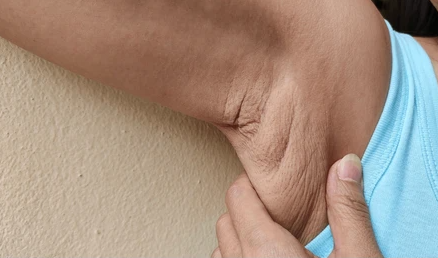
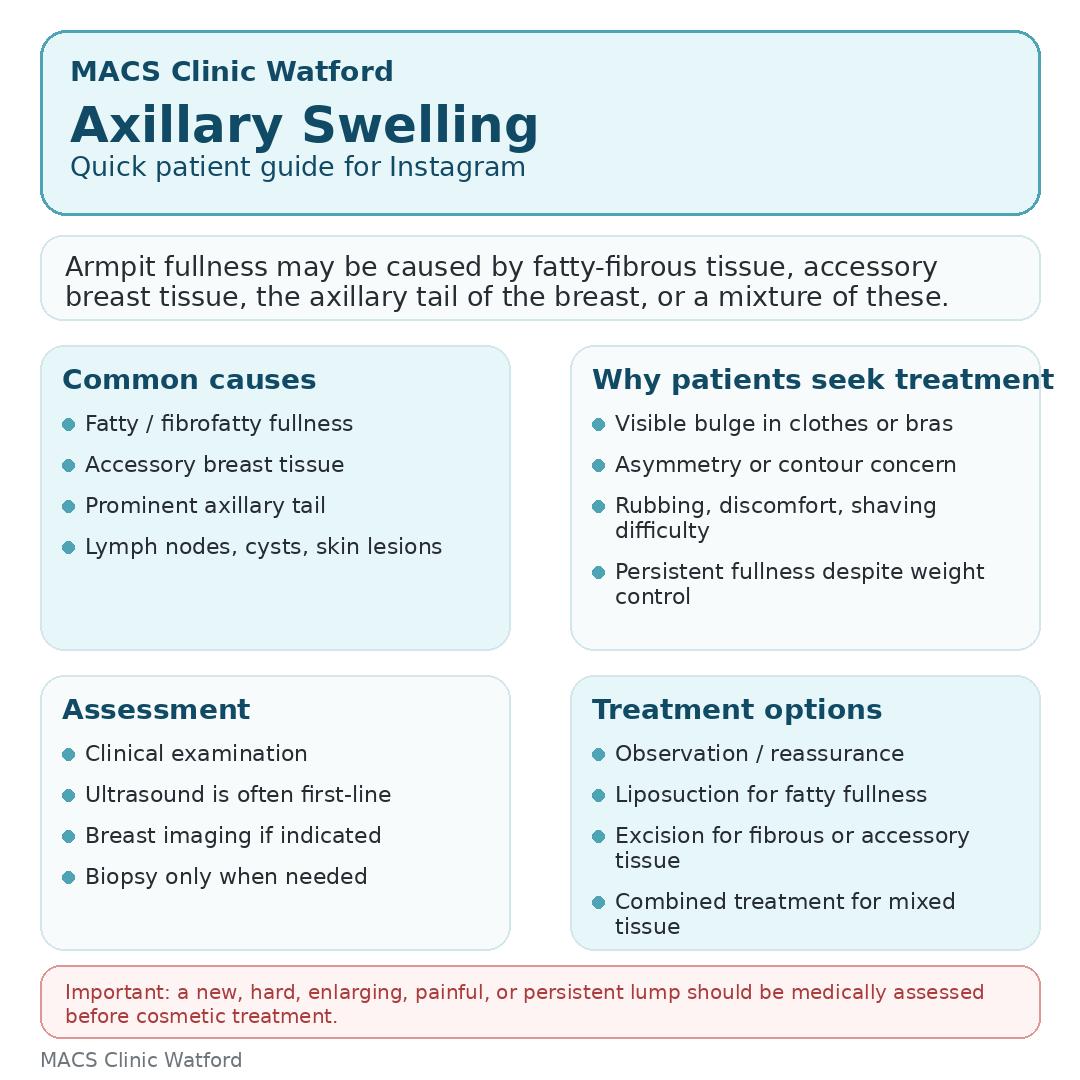
At a glance: Axillary swelling may be due to fatty/fibrous fullness, accessory or axillary tail breast tissue, enlarged lymph nodes, skin conditions, cysts or other benign masses. A new, persistent, painful or enlarging lump should be assessed before considering cosmetic correction.
What is axillary swelling?
- “Axillary swelling” means fullness, a lump, or tissue prominence in the armpit region. In aesthetic practice, the most frequent benign causes are local fatty or fibrofatty tissue, extension of breast tissue into the axilla (axillary tail of Spence), accessory breast tissue, or a combination of these.
- Some patients notice it on one side only; others have it on both sides. The size may remain stable, slowly increase with weight gain, or become more noticeable around hormonal changes.
Common causes
- Local fatty or fibrofatty tissue: a soft bulge caused by subcutaneous fat and fibrous tissue.
- Axillary tail or accessory breast tissue: breast tissue can extend into the armpit and may become more obvious with puberty, menstrual hormonal changes, pregnancy, breastfeeding, or weight change.
- Enlarged lymph nodes: these may enlarge with infections, inflammation, recent vaccination, or other medical conditions including malignancy.
Skin and sweat gland conditions: for example, hidradenitis suppurativa, recurrent boils, inflamed cysts or scarred nodules.
- Other benign lumps: lipoma, sebaceous/epidermoid cyst, scar tissue or post-operative change.
Why might a patient seek aesthetic correction?
- Visible fullness or asymmetrical fitting clothing, swimwear, bras or sleeveless outfits.
- Bulging over the bra line or friction against clothing.
- Discomfort during arm movement, exercise or shaving.
- Embarrassment, reduced confidence or difficulty achieving the desired body contour.
- Persistence despite stable weight and healthy lifestyle measures.
When medical assessments are especially important
- A new lump that has appeared recently or is increasing in size.
- Pain, redness, warmth, tenderness, discharge or fever.
- A hard, fixed or irregular lump.
- Associated breast symptoms such as a breast lump, skin dimpling, nipple inversion or nipple discharge.
- Systemic symptoms such as unexplained weight loss, night sweats or persistent fatigue.
Suggested investigations
- Clinical examination: assessment of the axillae, breasts, surrounding skin and medical history.
- Ultrasound: often the first investigation for a palpable axillary lump or swelling.
- Breast imaging when indicated: mammography and/or additional breast ultrasound, depending on age, examination findings and risk factors.
- Needle test or biopsy if recommended: fine needle aspiration or core biopsy may be advised if imaging raises concern or diagnosis remains uncertain.
- Occasionally blood tests or referral to a breast clinic / GP may be advised depending on the overall clinical picture.
Treatment options
- Observation and reassurance: appropriate when the swelling is benign, mild and not troublesome.
- Lifestyle measures: weight optimisation, supportive bras and reducing friction may help some patients, although true accessory breast tissue often does not disappear completely with exercise alone.
- Medical treatment: required if the cause is infection, inflammatory skin disease or another non-cosmetic diagnosis.
- Liposuction: may help when the swelling is predominantly fatty and skin quality is suitable.
- Direct excision: often considered when there is dense fibrous tissue, accessory breast tissue, excess skin, or a more defined lump that needs removal.
- Combined approach: a combination of liposuction and direct excision may be recommended for mixed fatty and glandular/fibrous fullness.
- Histology: removed tissue is commonly sent for laboratory analysis when appropriate.
Important practical points for patients
- The exact treatment depends on what the swelling is made of: fat, fibrous tissue, breast tissue, skin excess, lymph node enlargement, or mixed tissue.
- Aesthetic surgery should only be planned after appropriate assessment has excluded a significant medical cause.
- Scars, contour irregularity, numbness, seroma, under/over correction, neurovascular injury, incomplete excision recurrence or asymmetry are recognised risks of surgical treatment and should be discussed during consent.
- Not every axillary swelling is suitable for cosmetic correction.
Treatment Summary
Typical tissue pattern | Usual management | Comments |
Predominantly soft fatty fullness | Observation or liposuction |
|
|
|
|
Dense fibrous or glandular / accessory breast tissue | Direct excision |
|
|
|
|
| Combined liposuction + excision |
|
|
|
|
Suspicious / inflamed / uncertain lump | Medical work-up first |
|
Contact MACS Clinic
- Phone: 02070784378
- WhatsApp: 07792 648 726
- Email: enquiries@macsclinic.co.uk
- Website: www.macsclinic.co.uk
BOOK a FREE Video Consultation: https://calendly.com/macsclinic/free-video-consultation?month=2025-01